
In the next six months it will be subdued.

The expansion in September is highest since April, when the core sectors' growth stood at 2.6 per cent.

The eight sectors, which also include fertilisers, steel, natural gas, electricity and crude oil, had expanded by 1 per cent in June last year.

Buying and selling of exchange trade fund (ETF) units worth less than Rs 25 crore will now have to take place compulsorily on the stock exchange platform, according to a new rule which comes into effect on Tuesday. The fresh norm, which comes into being after two deferments, is aimed at boosting liquidity and reducing tracking error. At present, investors directly deal with the asset management companies (AMCs) for purchase and redemption of ETFs - passive schemes that track a particular benchmark such as the Nifty50 index.

Inflation data and global trends would be the major driving factors for the equity markets this week which after a record-breaking run took a breather in recent trades, analysts said. The overall market sentiment remains positive, supported by improving economic data and earnings but higher valuations can trigger bouts of profit booking, they said further. During the last week, which the 30-share BSE benchmark rose by 175.12 points or 0.30 per cent.

The S&P BSE Realty Index has emerged as one of the top-performing sectors, yielding a remarkable 45 per cent return over the past six months. The three leading players, listed by market capitalisation, have substantially enriched investor wealth by 43-70 per cent during this period. If the second quarter (Q2) of 2023-24 (FY24) updates from Macrotech Developers (Lodha) and Sobha, along with industry data for the quarter, serve as any indication, the trend of strong bookings for larger players is expected to continue.

The Sensex fell by 24.20 points, or 0.12 per cent, to 19,460.57, its lowest close since December 31, 2012.

The annual rate of inflation based on monthly wholesale price index (WPI) was 1.22 per cent in December as compared to 1.55 per cent in the previous month. It was 2.76 per cent in December 2019. The decline last month was mainly due to lower increase in food prices, data released by the Ministry of Commerce and Industry showed on Thursday. The food inflation for December dropped to 0.92 per cent as compared to 4.27 per cent in the previous month.

Leading indicators suggest economic activity has been disrupted after demonetisation.

Cumulatively, the eight core sectors grew by 4.2 per cent in 2017-18, lowest in the last three financial years.

"Within the broader index of industrial production, manufacturing has the largest of the weight. Having fallen off the cliff by 40.7 per cent during the April-June quarter, it is likely to witness a rebound when July IIP data is released. However, turnaround to positive growth trajectory could be some time away," Assocham said.

The eight core industries -- fertilisers, cement, steel, electricity, crude oil, coal, petroleum refinery products and natural gas -- have a combined weight of about 38 per cent in the Index of Industrial Production.

While the manufacturing sector grew by 13.3 per cent during the month, the performance of the mining and electricity sectors remained poor at 3.7 per cent and 4.2 per cent respectively, said the Index of Industrial Production released by the government on Wednesday.

The rate of price rise in the vegetable segment almost doubled to 7.47 per cent as against 3.92 per cent in September.
The government has authorised economic think-tank Centre for Monitoring Indian Economy (CMIE) to collect data to be used for compilation of the new series of Index of Industrial Production (IIP).

Expressing serious concern over contraction in industrial output in November, India Inc called for immediate policy interventions, including a rate cut by RBI, to prevent job losses and boost demand.

There are some companies in the sector that have seen a decline in revenues but their performance is not sufficient to cause such a decline in industrial production data.

In what could somewhat blunt the criticism over reliability of data, particularly Index of Industrial Production, the Union government has come out with rules prescribing Rs 1,000 fine for individual and Rs 5,000 for company if they neglect furnishing information to government agencies for statistical purposes or refuse to do so.

Apparel exports to Japan are expected to grow by 20-25 per cent year on year from the current $220 million on account of rising opportunities for domestic exports, AEPC said on Saturday. Apparel Export Promotion Council (AEPC) said that rising opportunities due to changing geopolitical landscape, government supports like production linked incentive, mega park scheme, improving the quality standard, getting sustainable and utilising benefits of free trade agreements with major markets are the key growth drivers. To promote exports to Japan, the council is organising a two-day show in Gurugram.
India may end the financial year with a seven per cent GDP growth rate, as the economic deceleration is expected to continue in the third quarter, said Montek Singh Ahluwalia, deputy chairman of the Planning Commission.

There is a significant amount of dispersion in the growth rates across different industries.

Brokerages believe that the Bharatiya Janata Party's (BJP's) stronger-than-expected showing in state elections reduces political risks for the domestic markets going into 2024. However, after the short-term excitement, the focus will soon shift to earnings, global liquidity conditions, and the interest rate trajectory. "BJP's win in the three state elections is much better than what exit polls suggested and reinforces the consensus expectations of a Modi win in the 2024 national elections with a greater likelihood of 300+ seats for the BJP.

The index of industrial production, which was negative in March, was positive in April - but just barely.
Among the Sensex firms, Bajaj Finserv, Tata Motors, Asian Paints, ITC, IndusInd Bank, State Bank of India, Tata Steel, Wipro, Infosys and Maruti were the major gainers. Tech Mahindra, HCL Technologies, Kotak Mahindra Bank, Titan and Larsen & Toubro were the major laggards.

Brokers said the market had its biggest weekly loss this year as Index of Industrial Production falling in March dampened investor sentiment amid worries over weakness in the economy.

A slowdown in hiring by India's top IT companies has resulted in a sharp increase in the industry's profit per employee in Q3FY23. The top four IT companies earned a net profit of 1.7 lakh per employee during October-December 2022, up 8.6 per cent from Rs 1.57 lakh in Q2FY23 and 16.3 per cent from a record low of Rs 1.47 lakh in Q1FY23. Earnings per employee in the third quarter were, however, still down 0.9 per cent on a year-on-year (YoY) basis.
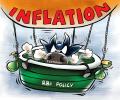
Analysts say RBI will cut rates because the liquidity crunch that began this time last year is still hurting the economy and also with an eye on the August industrial production numbers, which showed a contraction by 1.1 per cent -- the steepest in seven long years.
.jpg)
India's economy grew 4.7 per cent in 2013-14, following an expansion of 4.5 per cent in 2012-13. In the fourth quarter of 2013-14, growth remained subdued at 4.6 per cent, mainly due to a decline in manufacturing and mining output.

Among the different products, Air conditioners and LCD's are expected to have a higher growth rate for next few years in the industry.

Manufacturing activities in India eased marginally in September but remained in good shape amid companies hiring more workers and cooling price pressures, according to a monthly survey released on Monday. The seasonally adjusted S&P Global India Manufacturing Purchasing Managers' Index (PMI) indicated a strong improvement in the health of the Indian manufacturing industry, as companies stepped up production in tandem with a sustained increase in new work intakes. The PMI at 55.1 in September continued to be in expansion mode for the 15th consecutive month but was slightly lower than 56.2 recorded in August.
The Index of Industrial Production (IIP) for July 2007, released on September 12, showed the manufacturing sector decelerated to a growth rate of 7.2 per cent over July 2006, after many months of double-digit growth.

The overall market breadth was extremely positive as 1,868 stocks advanced while 951 declined.

The wholesale price-based inflation surged to more than a decade high of 14.23 per cent in November, mainly due to hardening of prices of mineral oils, basic metals, crude petroleum and natural gas. WPI inflation has remained in double digits for eight consecutive months beginning April. Inflation in October this year was at 12.54 per cent, while in November 2020 it was at 2.29 per cent. "The high rate of inflation in November 2021, is primarily due to rise in prices of mineral oils, basic metals, crude petroleum & natural gas, chemicals and chemical products, food products etc as compared to the corresponding month of the previous year," the commerce and industry ministry said in a statement on Tuesday.

Sources in the military establishment also said the present global scenario "necessitates a flexible and adaptive approach" to tackle defence and national security challenges.

IndusInd Bank, Bharti Airtel, HUL, M&M, Tata Steel, PowerGrid and Tech Mahindra too ended with gains on the BSE.

Mutual funds have ratcheted up Rs 53,700 crore (Rs 537 billion) through new fund offers (NFOs) in 2022 until November, against Rs 1 trillion in Calendar 2021, notwithstanding the number of launches this year eclipsing the 2021 tally. Industry insiders cite the absence of launches in popular categories as the reason behind lower collections this year. Typically, only NFOs in popular categories from major fund houses rake in the moolah.


The NSE 50-share index finally concluded at 10,417.15, up 14.90 points

The manufacturing sector, which accounts for over 75 per cent of the index, declined by 2.4 per cent against a growth of 4.1 per cent in December 2014.

Growth of capital goods at 9.6 per cent is inspiring as the investment cycle is expected to rebound in the coming months.
